
An underrated solar fuse or a poorly sealed solar fuse holder may continue to reduce the operating performance of the entire photovoltaic system for many years without detection. In more serious cases, it may even trigger an arc fault, which can lead to roof fires. Therefore, you need to fully understand the solar fuse & holder before purchasing.
What is Solar Fuse?

فتيل الطاقة الشمسية is an overcurrent protection device (OCPD) designed for DC photovoltaic circuits. When the fault current exceeds the rated threshold of the fuse due to قصر الدائرة, wiring error or reverse current generated by the parallel string, the fusible element automatically fuses and cuts off the circuit before the damage spreads to the component, كابل or inverter.
What is Solar Fuse Holder?

Solar fuse holder is a mechanical and electrical enclosure used to attach the fuse to the circuit while providing cable terminals. In the outdoor photovoltaic environment, the main function of the fuse holder is to isolate the fuse from moisture, dust, ultraviolet radiation and corrosive atmospheric environment. The contact resistance, corrosion resistance and IP Rating of the fuse holder directly affect the long-term reliability of the system.
| Comparison Table of AC Fuse and Solar DC Fuse | ||
|---|---|---|
| معامل | AC فيوز | الصمامات الشمسية DC |
| Arc interruption | Natural zero-crossing | Forced suppression |
| القوة الكهربائية | 250 فولت / 500 فولت تيار متردد | حتى 1,500 فولت تيار مستمر |
| Standard | IEC 60269-1/UL248 | IEC60269-6/UL2579 |
| Polarity requirement | بدون سلوفان | Must be polarity-rated |
| Arcre-ignition risk | ضئيلة | Severe if wrong type used |
| تعبئة المواد | Air or ceramic | Quartz sand (high-density) |
Types of Solar PV Fuse
String Fuse
String fuse is the main component of residential and commercial photovoltaic protection. It is installed at the positive/negative extremes of each parallel string in the مربع الموحد to prevent the current of the normal string from flowing back into the shaded string, that is, to prevent reverse current from causing damage.
النطاق المقدر: 1A ~ 30A, 600V ~ 1,000V DC
شكل عامل: 10 × 38 mm, 10 × 85 mm Cylindrical
المعيار المعمول به: IEC 60269-6 gPV
Inline Waterproof Fuse Assembly
The solar fuse and the fuse holder are pre-assembled into an integrated component in the weatherproof housing for the string wiring section at the front end of the junction box. Its rated protection rating is generally IP67 or IP68 and is suitable for roof, floor through-pipe installation or direct-burial applications.
Battery Bus and Midpoint Fuse
The battery bus and midpoint fuse are used in the نظام تخزين طاقة البطارية (BESS) supporting the photovoltaic array. The DC bus voltage can reach 1,500 V DC, and the expected fault current can exceed 80 kA. The fuse and fuse holder with corresponding high breaking capacity are required.
Fast-Acting Semiconductor Fuse
Ultra-fast fuse is used to protect the input stage of الحد الأقصى لتتبع نقطة الطاقة (MPPT) inverter and power electronics. Its role is to complete the fault clearing before the semiconductor junction temperature reaches the destructive threshold. Under this condition, the response speed of the standard slow-blow gPV fuse is not enough to provide effective protection.
Types of Solar Fuse Holder
Inline Waterproof Holder
Generally, it is a cylindrical two-part screw-together shell, which accepts a standard 10×38 mm or 10×85 mm fuse, and is usually rated as IP67 or IP68. The cable inlet is sealed by a Compression cable gland (PG thread or metric thread). It is suitable for the group cascade protection section of the roof system before reaching the confluence box.
Key selection points:
- Outdoor installation protection level must be ≥ IP65; iP67/IP68 should be selected for the wet or water risk area.
- The shell material is UV-Stabilized Polycarbonate or Nylon.
- Cable cross-section compatibility range: usually 4 mm² to 10 mm² (AWG 12 ~ 8).
Panel-Mount/Combiner Box Holder
It is generally used for DIN rail or لوحة الدوائر المطبوعة (PCB) installation inside the combiner box and re-combiner box to compactly accommodate multiple fuse components, usually directly integrated into the terminal block assembly of the junction box.
Key selection points:
- مواد الاتصال: Silver-plated copper is preferred in high maintenance frequency environment, which is better than Tin-Plated Copper.
- Finger-safe/touch-proof design (IEC 60529) compliant, suitable for non-professional electrician-contacted junction box scenarios.
- Equipped with fuse indicator window or blown-fuse indicator for quick visual fault diagnosis.
DIN-Rail Mounted Holder

It is generally a buckle-installed fuse holder for indoor or in-box DC distribution board. It is common in utility inverter room and DC bus protection components of battery system, usually suitable for larger fuses such as 14×51 mm or 22×58 mm.
Spring-Clamp/Ferrule Holder
A tool-free insertion and extraction fuse holder is used for a high-density confluence array with high maintenance turnaround time requirements. The spring contact can maintain a stable and consistent contact pressure on the fuse end cap no matter how the spring contact expands and contracts under the thermal cycling condition.
Integrated Fuse Block مع متعدد القطب
Multi-position fuse block can accommodate 6, 12 or 24 fuse positions on a single DIN rail. The standard configuration of utility-class junction box. Each location is protected by an independent fuse, and Inter-Position Isolation prevents the spread of cascading faults.
كيف Match Solar Fuse with Fuse Holder?
The specification mismatch between the fuse body and the fuse seat is one of the main reasons for the on-site failure. The following compatibility matrix can be used as a preliminary checklist:
Solar Fuse and Solar Fuse Holder Compatibility Matrix Table | |||
|---|---|---|---|
| Fuse Form Factor | Common Holder Type | تطبيق نموذجي | IP Class Needed |
| 10x38mm | Inline waterproof, panel-mount | Residential string fuse | IP67 في الهواء الطلق |
| 10x85mm | Panel-mount, DIN-rail | Commercial combiner box | IP54 indoor enclosure |
| 14x51mm | DIN-rail,fuse block | Commercial/utility DC bus | IP54 indoor enclosure |
| 22x58mm | Bolt-down fuse block | Utility re-combiner | IP54+ للاستخدام الداخلي |
| Inline molded | Molded assembly | Direct-burial string wiring | IP68 |
It is necessary to confirm that the current rating of the fuse holder is equal to or higher than the rated current of the fuse: if the 20A fuse is loaded into the 15A rated fuse holder, even if the fuse itself has never been fused, the contact terminal of the fuse holder will also accelerate aging failure due to continuous overheating.
The following 7 selection points completely distinguish reliable installation from on-site failure.
نقطة 1: The fuse is selected according to the string parameters, not the inverter parameters.
Solar DC fuse must be selected based on the string short-circuit current, not the input rating of the inverter. According to IEC 62548:
- القيمة الدنيا: In ≥ 1.25×Isc
- أقصى: In ≤ 1.56×Isc
- Hardness upper limit: In ≤ component maximum overcurrent protection rating (IOCPR, printed on the back of the component nameplate)
مثال على الاختيار: component Isc = 10.5A → minimum fuse = 13.1A, maximum fuse = 16.4A, selection result: 15A gPV fuse. If IOCPR = 15A, then 15A selection is valid.
نقطة 2: The rated current of fuse holder must be higher than that of fuse.
The continuous rated current of the fuse holder must be at least one standard step higher than the rated current of the fuse. 15A fuse should be equipped with a fuse holder with a rated current of at least 20A. This ensures that the fuse seat contact terminal will never become a thermal weak point in the circuit.
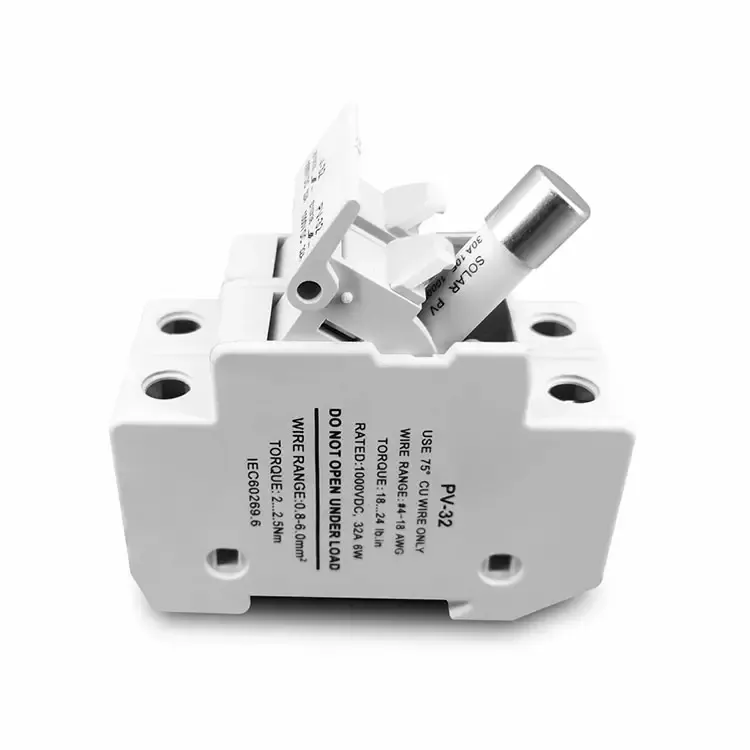
نقطة 3: The DC voltage rating of fuse and fuse holder must be independently verified separately.
Solar fuse and fuse holder have their own independent DC voltage ratings. The fuse with rated 1,000 V DC is loaded into the fuse holder with rated 600 V DC. The combination formed does not conform to the specification, and the arc clearance distance inside the fuse holder is insufficient, which has potential safety hazards. The datasheets of the two components must be checked separately.
نقطة 4: Select the protection level according to the installation area (المنطقة), rather than judging by outdoor generally.
| Solar Fuse Holder Installation Area Table | ||
|---|---|---|
| المنطقة | Recommended IP | المنطق |
| Indoor enclosure (IP54 box) | IP20 holder acceptable | Enclosure provides primary protection |
| Outdoor combiner box (IP65) | IP65 holder | Matched to enclosure rating |
| Open rooftop,no enclosure | IP67 inline holder | Direct rain and UV exposure |
| Underground conduit | IP68 inline assembly | Potential submersion in conduit flooding |
| البحرية/الساحلية | IP68 + stainless hardware | Salt spray corrosion protection required |
نقطة 5: ملابس حرارية derating should be considered in high temperature environment.
Photovoltaic fuse and its fuse holder are subject to heat derating constraints. In the tropical climate, the ambient temperature in the roof confluence box can reach 60℃. At this time, the fuse rated 15 A continuous current may need to be raised to 20 A to maintain the equivalent effective protection threshold. Be sure to check the derating curve provided by the manufacturer.
نقطة 6: Select the contact material according to the environmental conditions, not only the cost.
القصدير-pمتأخرا cOpper contact: It is suitable for installation in dry, low humidity and temperate climate with low cost.
الفضةpمتأخرا cOpper contact: This is mandatory for coastal, tropical, industrial environments, or any scene where sulfurous compounds or salt fog are present. The resistivity of silver oxide is much lower than that of tin oxide, which can keep the contact resistance stable during decades of operation.
In order to save a few cents of the contact material cost of each fuse holder in harsh environments, it is the most expensive False Economy in the design of photovoltaic systems.
Point 7: Planning maintenance accessibility from the design stage.
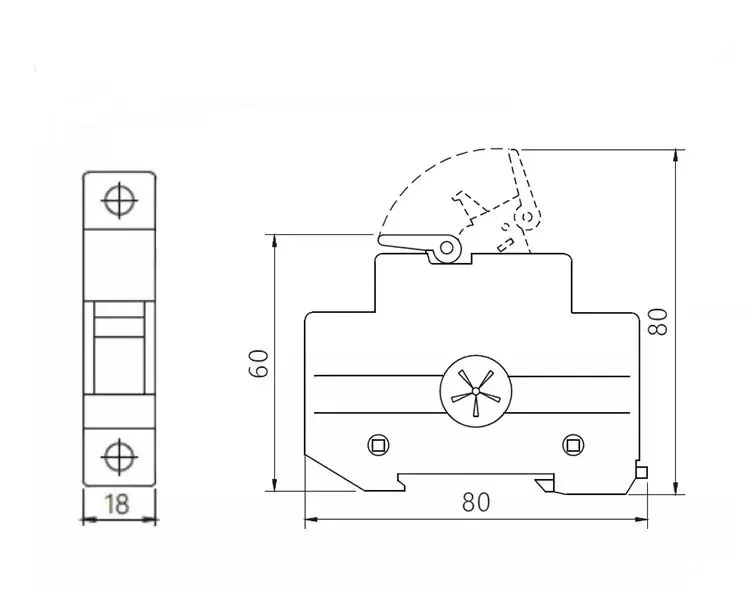
A solar fuse holder that needs to dismantle the entire header to replace the fuse must result in a long downtime. Specification requirements should be clear:
- For the junction box with high number of strings, front-access or tool-free spring-clamp fuse holder is selected.
- For junction boxes without remote monitoring, the blown-fuse indicator (neon or LED) is configured. The laminated schedule is pasted on the inner side of the confluence box cover that indicate the string number and rated value corresponding to each fuse.
Also you maybe like read related articles:
Overvoltage Protector: Ensures YourElectricity Safe With DIN Rail Voltmeter
DIN Rail Voltmeter: The Ultimate Guide toElectrical Safety
Photovoltaic Cables: The Key to EnsuringSafe and Efficient Solar Wiring
Since the fuse is pre-installed in the junction box, does it still need to pay attention to the selection of solar fuse holder?
The integrated fuse holder has been integrated in the junction box, but you still need to verify whether the rated current, protection level and contact material of the fuse holder match the specific requirements of the system. Pre-installed is not equal to correctly normalized.
Can the same fuse holder be compatible with both 600V DC and 1,000V DC fuses?
Only when the fuse holder has a clear dual voltage rating. The voltage rating on the fuse holder involves its internal arc clearance distance. The solar DC fuse rated at 1,000 V DC is loaded into the fuse holder rated at 600 V DC, and the combination formed does not meet the specification and has potential safety hazards.
How to determine whether the Solar Fuse Holder needs to be replaced or simply cleaned?
After cleaning, the contact resistance is still higher than 1 m
Ω, visible deformation, shell cracking, or IP seal failure (visible moisture inside the fuse seat) constitute the reasons for the replacement. If there are doubts, considering the risk of unqualified fuse seats continuing to be used, the cost of replacing materials is negligible relative to potential losses.
What is the actual difference between IP65, IP67 and IP68 for solar fuse holder?
IP65 represents dustproof (fully enclosed) and water column from any direction; IP67 stands for dust and short-term immersion (Temporary Immersion, 1 meter deep, 30 minutes); IP68 stands for dustproof and continuous immersion (depth and time according to manufacturer’s specifications). The actual minimum requirement of the roof inline fuse holder is IP67; IP68 should be selected for underground pipe-through applications.
Is it acceptable to mix different brands of fuses in the same junction box?
From a technical compliance perspective, all fuses are permitted as long as they meet the same IEC 60269-6 gPV specification and have the same ratings. However, the time-current curves of different manufacturers may be different within the standard tolerance range, and asymmetric protection may be formed in the parallel string array. Best practice is the use of a single brand and the same production batch (Batch) fuse in the same junction box.