In electrical power systems, both distribution boxes and distribution boards are responsible for power distribution and protection. Many people confuse them, but they differ significantly in structure, purpose and installation environment. Understanding these differences helps in making the right choice and improving electrical safety and efficiency.
What is a Distribution Box?
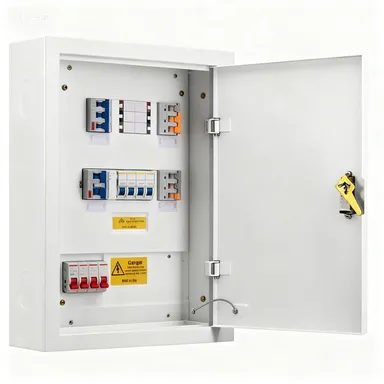
A distribution box is a compact electrical enclosure designed to help manage local power distribution securely. Unlike distribution boards that handle large-scale circuit management, it focuses on organizing and protecting electrical connections in smaller and specific areas.
What is a Distribution Board?
.webp)
A distribution board acts as a central hub where power from the mains supply is distributed and sent to different circuits throughout the building that manage how power flows from living room lights to heavy industrial equipment. It includes circuit breakers or fuses that automatically cut off power in case of overload or failure that can protect people and equipment from potential damage or danger.
In contrast, the distribution board is more suitable for high-load power systems and is a key component of the electrical system.
Differences between Distribution Box and Distribution Board
| Comparison Items | Distribution Box | Distribution Board |
| Safety Features | IP-rated sealing, dust and moisture protection | Circuit breakers and surge protection |
| Function | Terminal circuit distribution and protection | Main power control and centralized distribution |
| Material | Plastic, polycarbonate or metal | Steel or aluminum for durability |
| Size & Design | Compact, portable, flexible | Large, fixed, centralized |
| Cost | Lower (simple enclosure, fewer parts) | Higher (advanced features, more components) |
| Lifespan | Shorter—depends on environment and usage | Up to 20+ years with proper care |
| Compliance | Typically rated by IP codes, local standards | Must meet IEC/NEMA standards |
| Maintenance Method | Occasional visual checks. It is easy for general users to operate. | Regular inspections and testing.It requires professional electrician maintenance. |
| Load Capacity | Medium and low load | High-load systems |
As shown in the table above, distribution boxes focus more on the safety and distribution of terminal circuits, while distribution boards are responsible for centralized management of the overall power supply.
How to choose the right one?
The choice of which device to use depends entirely on where you will be using electricity and how much electricity you will be using.
In your own home or an apartment
You will need a home distribution box that is responsible for receiving power from the building entrance and then safely distributing it to various corners of your home such as lighting, sockets, air conditioning and kitchen appliances, etc. Its size and functions are perfect for home use; it can be recessed into the wall, which is both aesthetically pleasing and space-saving.
When choosing, you should mainly consider: selecting a power distribution box with enough circuits based on the number of appliances in your home; then deciding whether to install it in the wall (recessed mounting) or mounted on the exterior wall (surface mounting); finally, be sure to choose a reliable brand with safety certifications.
In a small factory, workshop, large shop or an entire office building
you’ll need a distribution board. Because you’ll be handling a much larger power capacity than a household can. It receives large amounts of power from the grid and then distributes it to various areas, tenants or large machines within the building. It’s more powerful, integrating main switches, branch circuit controls and meters. Typically, this forms a system: the main distribution board distributes power to the distribution boxes on each floor and these boxes then supply power to the specific equipment.
Finally, if your power needs are temporary such as at construction sites, outdoor events or temporary stalls, a portable distribution box is the best choice. It’s specifically designed for such mobile and temporary scenes that features waterproof sockets and leakage protection and is plug-and-play to offer great convenience and flexibility.
Q1: Is a larger distribution box always better?
In reality, you should choose an appropriate capacity based on your load requirements to avoid waste.
Q2: Can distribution boxes and distribution boards be used interchangeably?
Their applications and functions differ and they cannot be arbitrarily substituted.
Q3: Do household electrical distribution boxes not need to be inspected regularly?
After long-term operation, aging wiring may cause safety hazards and should be inspected regularly.
Q4: Are distribution boards and fuse boxes the same?
Many people confuse distribution boards with fuse boxes. In fact, their functions are not entirely the same.
Fuse boxes are mainly used for overload protection, cutting off the circuit when the current is too high; The distribution board provides protection functions and also centrally controls and distributes multiple circuits that enable more comprehensive control functions.
Learn More
The distribution box and distribution board each have their own job. Distribution boards are best suited for stationary systems with numerous circuits, while distribution boxes are better suited for small or temporary applications. Understanding the differences between the two will help you choose the right switchboard based on your space and needs.
If you are still unsure how to choose, the QJC Electric team is ready to help. Feel free to contact us for advice or to find the best solution for your power distribution needs.