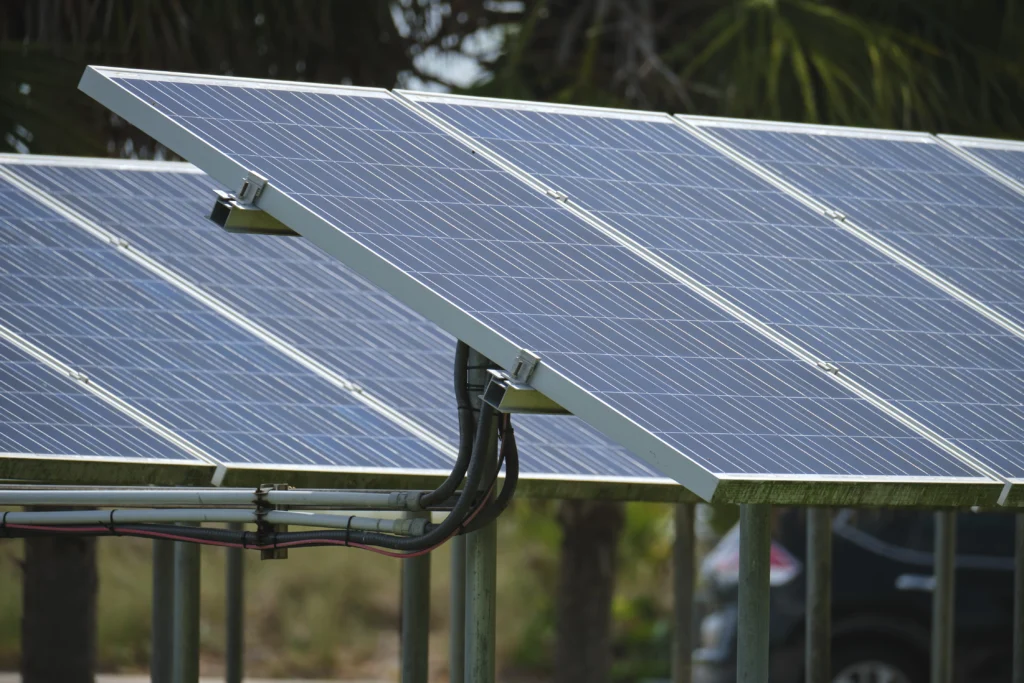
The MC4 connector is the most widely used electrical connector in the solar energy industry. Whether it is a small rooftop photovoltaic system or a utility-class large-scale solar power station, mastering the knowledge of MC4 connectors is the basis for safe, reliable and standardized wiring.
This article provides a complete in-depth analysis from technical specifications, purchase recommendations to actual installation operations.
“MC4” stands for Multi-Contact, 4mm – a name derived from the Swiss manufacturer Multi-Contact (now incorporated into the Stäubli Electrical Connectors) and the diameter of the contact pin inside the connector is 4mm. The MC4 solar connector is designed for outdoor photovoltaic (PV) application scenarios. It has three core characteristics: weather resistance, high pressure tolerance and safe locking.
What is the MC4 Connector?

An MC4 connector is the industry-standard, weatherproof electrical connector for connecting solar panels and components in photovoltaic (PV) systems, named for its manufacturer (Multi-Contact, now Stäubli) and 4mm contact pin. These durable connectors provide secure, reliable, and watertight connections for outdoor use, featuring a positive locking mechanism to prevent accidental disconnections, making them crucial for building solar arrays.
How does MC4 Connector Work?
An MC4 electrical connector adopts a snap-lock coupling mechanism, which requires special tools to unlock. This is a deliberate safety design to prevent accidental disconnection in the charged state. The connection process is as follows:
- The male connector features a protruding 4mm cylindrical pin.
- The female connector contains an embedded socket that matches the pin.
After the two are inserted into each other, the plastic locking collar is clamped to form a waterproof and anti-vibration sealing connection.
MC4 disconnect tool (also known as unlocking key/spanner) must be used when unlocking to avoid damaging the connector housing.
This locking mechanism is crucial in solar systems – the connection point is exposed to cyclic stresses of wind, vibration and thermal expansion and contraction for a long time, and any loosening means power generation loss and potential fire risk.
MC4 Connector Technical Specifications
Understanding the technical specifications of MC4 electrical connectors helps to select components that meet the electrical requirements and environmental requirements of the system.
| MC4 Connector Technical Specifications Table | |
|---|---|
| Speciafications | Detail |
| Rated Voltage | 1000V DC(IEC)/1500V DC(UL) |
| Rated Current | 30A-45A (depending on gauge) |
| Contact Resistance | <0.5 mΩ |
| IP Rating | IP67/IP68 |
| Operating Temperature | -40°C to +85°C |
| Compatible Wire Gauge | AWG 12–AWG 10 (2.5mm² – 6mm²) |
| Material | UV-resistant PPO/PA housing, tinned copper contact |
| Certifications | TÜV Rheinland, UL 6703, IEC 62852 |
What does IP68 protection level mean for MC4 connectors? IP68 is the highest Ingress protection rating for dust and water resistance: fully dust-proof and withstands continuous immersion. This makes the MC4 connector suitable for ground installation systems, marine applications and heavy rainfall climates.
5 Types of MC4 Connectors for Solar Panels
Not all MC4 connectors are the same. The following are the 5 main types that are common when building or expanding solar photovoltaic systems:
Standard MC4 Connector Pair (Male + Female)
The most common form, used to connect single solar panels in series or extend cable routing, is sold in pairs (one male and one female). This is the default configuration of MC4 connectors for solar panels in residential PV systems.
MC4 Y-Branch/Parallel Connector
Also known as “T4 Splitter” or “MC4 Branch Connector”, is used to connect two solar panels in parallel into a cable. The Y-type connector is connected in two ways:
- 2-to-1 Female: two positive input, one positive output
- 2-to-1 Male: two negative input, one negative output
The use of Y-type connectors can increase the total current (Amperage) of the system without an additional combiner box.
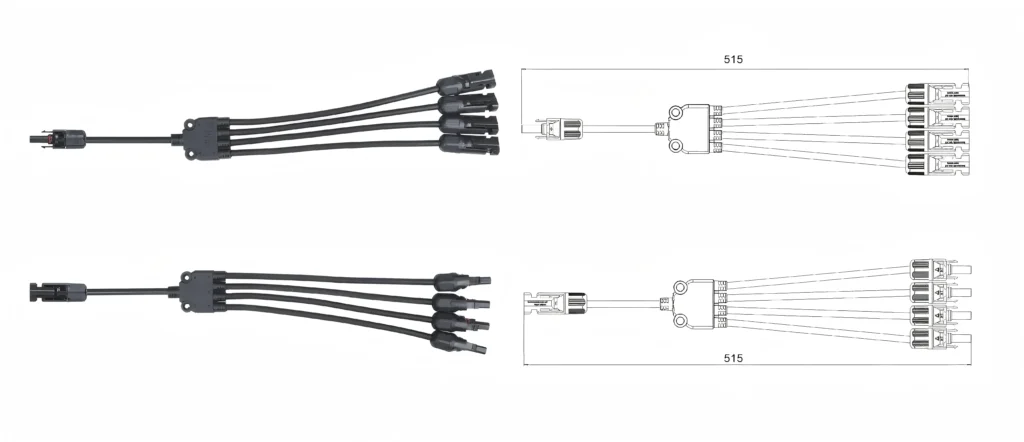
MC4 Multi-Branch Connector (3-to-1, 4-to-1)
For larger systems, multi-branch MC4 connectors allow 3 or 4 strings to converge directly at the connector level and are widely used in commercial and utility-grade solar arrays.
MC4 Extension Cable (Pre-assembled)
The extension cable of the MC4 solar connector is pre-terminated that eliminates the field crimping process. The common specification lengths are 1m, 2m, 5m and 10m, which are very suitable for DIY solar projects and trailer and off-grid systems.
MC4 Compatible Connectors (Third-Party)
Many manufacturers produce connectors with “MC4 compatibility” as their selling point, including Amphenol Helios H4, Tyco Solarlok and various OEM brands.
QJC Note: Although physically intermateable in appearance, it is not recommended to mix different brands of connectors. IEC 62852 standard and most installation specifications require the use of the same brand at both ends of the same connection point to ensure rated contact performance and Warranty Compliance.
How to Choose the Best MC4 Solar Connectors?
Choosing the right MC4 connectors for solar panels is much easier than the price. The following are the key evaluation dimensions:
Certification & Standards Compliance
Always verify whether the connector holds an authoritative certification, including:
- TÜV Rheinland (Gold Standard Certification for European Photovoltaic Components)
- UL 6703 (U.S. NEC Code Installation Requirements Certification)
- IEC 62852 (International Standard for Photovoltaic Connectors)
Uncertified connectors may not be able to meet the voltage, current or temperature requirements of the system, and may also lead to the failure of the inverter or panel/module warranty.
IP rating
For all outdoor or roof installation scenarios, at least select the IP67 level. The IP68 level is recommended for ground installation systems or areas prone to water accumulation.
Wire gauge compatibility
Contacts of MC4 electrical connectors are distinguished by wire specifications. Applying 4mm 2 contact to 2.5mm 2 wire will lead to poor crimp, increase the contact resistance, and then cause the risk of arcing. The specification of the contact must be strictly matched with the cable cross-section.
Material Quality
UV-Stabilized PPO or PA Housing: does not crack or fade after many years of sun exposure
Tinned/Silver-Plated Copper Contact: effectively inhibits long-term oxidation and reduces contact resistance.
How to Install and Crimp MC4 Connectors?
The installation quality of the solar connector directly affects the safety and service life of the system. Faulty crimping is one of the main causes of DC arc fault in the solar system.
Tools Required:
- MC4 ratcheting crimp tool (match the wire gauge)
- MC4 disconnect/unlocking tool
- Wire stripper
- Multimeter (for on-off and polarity testing)
Step-by-step installation process of MC4:
- Strip the Cable: strip the 7-8mm insulation skin from the end of the solar cable and take care not to scratch the Conductor Strands.
- Insert the Conductor: the bare conductor is completely inserted into the back end of the contact pin or socket to ensure that no monofilament is exposed.
- Crimp the Contact: select the corresponding die on the ratchet crimping tool to perform crimping. The qualified crimping shall meet the standard of gas-tight crimp – that is, there is no air gap between the conductor and the contact piece to ensure mechanical strength and electrical conductivity.
- Insert the Contact into the Housing: push the crimped contact into the connector housing until a crisp audible click is heard, confirming that the lock is in place.
- Assemble the Cable Entry Seal: insert the cable gland nut and the sealing ring into the cable and tighten to meet the sealing requirements of the corresponding protection level.
- Continuity & Polarity Test: before connecting to the charged string, the multimeter is used to confirm that the continuity is normal and the polarity is correct.
- Mate the Connectors: insert the male head into the female head until the locking collar clicks, indicating that the connection is securely in place.
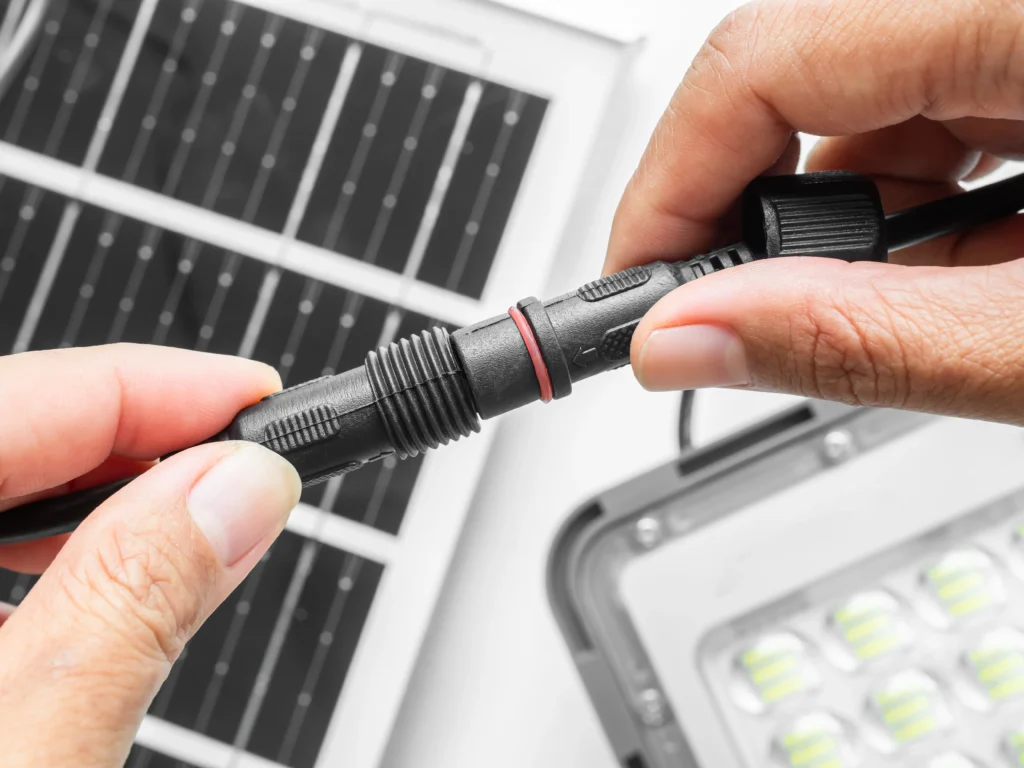
Safety Warning: do not plug the MC4 connector in the live/energized circuit state. Once the direct current arc in the solar energy system is generated, it is extremely difficult to extinguish, and the risk is extremely high. Before operation, the string must be disconnected and isolated by a DC disconnect switch.
Solar System Applications for MC4 Connectors
Residential Rooftop Solar System
In a typical residential photovoltaic installation, the MC4 connector connects the solar panels in series into a string. Taking the standard string of 10 components as an example, the string voltage can reach 300-600 V DC. Correct use of MC4 ensures that the connection points on the roof slope remain safe and waterproof for more than 25 years of service life.
Commercial & Utility-Scale Solar
In large-scale systems, the number of MC4 connectors for solar can reach hundreds or even thousands of connections. The Y-type and multi-branch connectors reduce the Balance of System Cost (BOS) by reducing the number of combiner boxes. Commercial projects often require a unified brand connector and a test record for each connection point to be archived for traceability.
Off-Grid, RV & Marine Solar
In mobile or off-grid systems, solar connectors are subjected to vibration, salt spray and irregular maintenance. Pre-installed MC4 extension cables are popular in such scenarios due to their ease of installation. The marine application scenario strongly recommends the use of IP68-level connectors.
Portable & Flexible Solar Panels
Foldable solar panels for camping and emergency power supply generally use MC4 solar connector as the standard interface, which is directly compatible with most solar charge controllers and portable power stations on the market.
Troubleshooting Common MC4 Connector Problems
Even connectors with installation specifications may have performance problems over time. Here are the most common fault diagnosis and treatment methods:
| Troubleshooting table of MC4 connector common faults | ||
|---|---|---|
| Problem | Likely Cause | Solution |
| Burnt or discolored connector | Undersized contact or poor crimp | Replace connector; re-crimp with correct gauge |
| Water ingress/corrosion | Damaged seal or incompatible brand mix | Replace with IP68connectors;use single brand per pair |
| Voltage drop across connection | High contact resistance from oxidation | Clean contacts or replace;check crimp integrity |
| Connector won’t lock | Debris in locking collar | Clean housing; inspect for mechanical damage |
| Ground fault error on inverter | Pinched cable under connector gland | Inspect cable entry;replace damaged connectors |
Annual Maintenance Tip: Use a thermal imaging camera or infrared thermometer to scan all MC4 connection points during peak power generation. If the temperature of the joint at a certain place is more than 10 ° C higher than that of the adjacent connection point, it indicates that the contact has deteriorated and should be replaced immediately.
Why MC4 Connector is Always the Standard Choice for the Solar Industry
With its excellent snap-lock mechanism, IP68 all-weather protection, high-voltage and high-current carrying capacity, and decades of field-proven reliability, the MC4 connector has firmly established its position as a universal interface for solar cabling. From DIY off-grid systems to utility-grade photovoltaic power stations, solar panel connectors are the first choice for installers around the world.
Whether you are purchasing MC4 connectors for solar panels for the first time for photovoltaic systems, or troubleshooting aging arrays, the core principles remain the same: purchase certified products, match wire specifications, perform crimping operations, and do not mix brands at the same connection point. Following these basic guidelines, your MC4 connection points will be more durable than almost all other components in the system.
Can all MC4 connectors be compatible with each other?
Not necessarily. Although most MC4 solar panel connectors can be inserted in pairs in physical form, mixing different brands may lead to a decrease in IP protection level, an increase in contact resistance, and a violation of IEC 62852 international standards. For safety and quality assurance compliance, always use Matched Pairs from the same manufacturer.
How do I choose the right MC4 connector for my solar panel system?
Choosing the right MC4 connector is critical for the safety, efficiency, and longevity of your solar system and involves matching the connector’s specifications to your system’s electrical output and environmental conditions.
What are the top recommended tools for crimping and disconnecting MC4 connectors?
When working with MC4 connectors (the standard for modern solar PV systems), your tool choice depends heavily on whether you are a DIYer or a professional. Poor crimps are the cause of solar fires, so using a tool with a ratcheting mechanism is non-negotiable.
What are the main differences between MC4 and MC6 connectors?
The main differences between MC4 and MC6 connectors lie in their contact pin diameter, resulting in different current capacities, mechanical stability, and target applications within solar photovoltaic (PV) systems.
Can I connect MC3 and MC4 connectors together?
No, you generally cannot directly connect MC3 and MC4 connectors together. Because the electrical contact diameters, mechanical locking, and safety ratings differ, MC3 and MC4 do not mate correctly or safely on their own.