
Single Phase vs Three phase meter are indeed different, each designed for specific needs. The following comparison highlights the main distinctions between these two smart meter systems. QINJIA Electric delivers reliable power measurement solutions for both home and business applications. Let’s take a closer look at how single-phase and three-phase meters compare.
Table of Contents
Single-phase meter: What is that?
A single-phase meter is used to measure electricity in circuits with two wires: one phase wire and one neutral wire.
This setup is common in homes, which is why it’s often called “residential voltage.” The phase wire delivers the electrical load, while the neutral wire provides a return path.
In most cases, the voltage is 230 Volts with a frequency of 50 Hertz. This type of meter is designed for basic household power distribution, where it monitors and records energy use.
What are the advantages of a single-phase energy meter?
Single-phase energy meters offer several benefits, especially for residential use. They are commonly used in homes because most household devices, such as lights, fans, televisions, and refrigerators, require only a small amount of power.
These meters are simple to operate and have a lightweight, compact design. When the voltage increases, the current flowing through the wires decreases, making the system efficient. Single-phase connections can handle loads up to 5 Horse Power, ensuring reliable performance for typical home needs.
Overall, single-phase meters provide effective power transmission and are well-suited for domestic applications. For more details, we will compare single-phase and three-phase energy meters later in the article.
Three phase meter: What is that?
A three-phase energy meter is used to measure electricity in systems with three separate power lines and one neutral wire. In this setup, the three conductor wires are spaced 120 degrees apart.
There are two main ways to configure a three-phase meter: Star and Delta. The Star configuration uses both a ground and a neutral wire, while the Delta setup does not require a neutral wire.
What are the advantages of a 3 phase energy meter?
Three-phase energy meters offer several key benefits. They can power heavy industrial motors directly, without needing extra starters, because they deliver enough torque. With three phases, the voltage supply is more stable and consistent.
These meters are ideal for running large machines, making them suitable for commercial and industrial settings where high power is needed. Additionally, three-phase systems use less conducting material, which makes them a more economical choice.
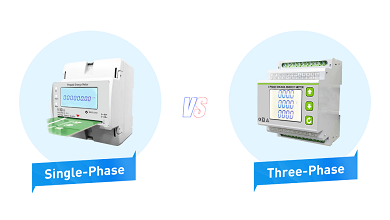
Single phase vs Three phase meter: Differences
Single phase vs Three phase meter differ in several ways. In a single-phase system, electricity flows through one conductor, while a three-phase system uses three separate conductors. Single-phase meters usually handle up to 230 Volts, but three-phase meters can support voltages up to 415 Volts.
A single-phase meter typically needs two wires for operation. In contrast, a three-phase meter requires three phase wires and one neutral wire, making its wiring more complex.
Three-phase meters provide a more reliable power supply. If one phase fails, the other phases can still deliver electricity, reducing the risk of a complete outage. In a single-phase system, any disruption affects the entire supply.
Additionally, three-phase systems are more efficient. They use fewer conductors for the same circuit compared to single-phase meters. Overall, single-phase meters are simpler, while three-phase meters are better suited for higher power needs and greater reliability.
FAQ
What are energy meter?
Static Energy Meters are electronic devices used to measure electrical energy consumption in a static (non-moving) manner.
How are energy meter installed?
Installed by qualified technicians near the main electrical panel, typically connected directly to the incoming power lines.
What are the benefits of installing energy meter ?
Accurate energy measurement, real-time monitoring, billing accuracy, and potential for energy conservation.
How accurate is energy meter?
Highly accurate, with modern static energy meters providing precise measurements.